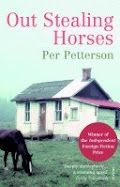

The nearest I have ever been to Norway is my handcream- so this book was like getting off a plane and knowing straight away you are in a different country by the landscape, the air, the smell. I loved the descriptions of smells- ' the smell of roasting meat and coffee in the air, the smell of smoke, and timber and heather and sun-warmed stones and some special scent I had not noticed anywhere else...' And the descriptions of weather- 'a grey layer of cloud floats across the sky like a duvet..' and of watching the stars.
'Out Stealing Horses' is the code word for a cell of the resistance movement in Nazi-occupied Norway in 1944. Although Barbara had previously posted about the resistance movement, I stupidly had not realised this was a theme of the book until Franz reveals it to Trond. I was as surprised as Trond! I think this is tribute to the light, subtle touch with which Petterson (and his translator Born) writes. I liked this lightness of touch- the language wasn't florid or fancy, yet the elemental descriptions were so effective- wood, earth, stone, water, sky, wind, green ,river. I felt I was there.
Just like the waterways Barbara previously mentioned, I thought the rhythm of the narrative was like a flowing river, the current overturning stones (buried facts) as the water (plot) twists and turns.
Trond's desire to get attention from his father; his hope that the summer has somehow bonded the two of them together; his simple trust in his father; his hope and faith that his father will soon leave the remote forest and return to Trond and his mother and his sister- all this hope, in spite of having glimpsed the 'other life' his father led as a protagonist in the resistance and as the lover of Jon's mother- all this hope is cruelly dashed with the letter that curtly announces his father's intention not to return.
The ensuing years living without a father has a profound effect on Trond's life, his relationship with his wife and eventually his relationship with his own daughter. His inability to communicate with her mirrors his own father's self-interestedness.
It is not surprising that Trond is drawn back to living in the forest, in a place similar to that which he shared the summer of 1948 with his father. He says of that time- 'I was the forest'. His father goes around sniffing the branches, and the scents of the forest are in Trond himself: 'Before I fell asleep I put my forehead against the coarse timbered wall sniffing the faint scent of the forest it still held'. As if by inhaling these scents he can some how get closer to his father. I found this very poignant, heart-wrenching stuff.
The reconciliation of his abandonment comes in meeting Lars again years later. From the age of 10 Lars has enjoyed the attentions of Trond's father- who has set up home with Lars' mother. Trond does not explicitly say how this makes him feel- you can only imagine. Meeting with Lars is unexpected and at first Trond is not too happy with the ensuing flood of memories- 'it ties me to a past I thought was well behind me and pulls aside the fifty years with a lightness that seems almost indecent'. We think we have put the past behind us but it can rear up at any moment. The falling of the tree is hugely symbolic. We are told elsewhere that it is an unusual event for these trees to fall- they usually bend with the wind. The fallen tree is the huge blockage in Trond's life caused by the abandonment of his father. It almost kills him. He literally cannot get on with his life without removing it- it is pinning shut the door of his toolshed!
The cutting up and removal of the tree by Trond and Lars, working together, not discussing the past but knowing, sharing is also symbolic. Cutting out dead wood. Removing the blockage. Moving on. Reconciliation.
Once the blockage is removed, up pops Trond's daughter. We glimpse how much she is craving Trond's love, just as Trond craved his father's. We feel the daughter's pain. A father's abandonment has affected the next generation also.
What happens to us in childhood shapes our lives. Such a well-known fact, it is almost a cliche. Psychotherapists start with childhood, but most people in the world do not have access to 'therapy'. Petterson has shown very effectively the subtle and lasting consequences that can arise from the decisions we take and that our children will be affected and moulded by who we are and what we do. I wonder- did Trond's father have any idea what he was doing to his son? If so, would he have done things differently? Do we have sympathy with him?- he was a 'hero' of the Resistance after all.
I found myself thinking about what 'blockages' there are in my own life.
'I look back to that time, I see how each movement through the landscape took colour from what came afterwards and cannot be separated from it'
I loved this book- a little gem, with so much in it. I want to read it again and have recommended it to my actual reading group- thank you Barbara!
Postcript: I also loved his relationship with his dog- very accurate interpretations of doggy language!