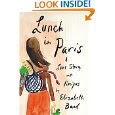
An expat American woman studying in London meets a French professional and newly-minted Ph.D at a digitisation conference, they eventually have lunch, and while enjoying what has to be the most sensual meal I've read about in years, decide to have their after-lunch tea at his apartment. Both realise their desire for the other, and for her part, the American, though hesitant about being viewed as potentially slutty, decides her French man is nonetheless worth that risk. So begins Elizabeth Bard's Lunch in Paris...
Described by the author as a love story with recipes, the book, an engaging read from start to finish, pulls its readers along on a budding romance that blossoms into marriage, the melding of two linguistically challenged but loving families and an on-going exploration of what it can be like to live in a culture different from one's own.
Growing up as an expat myself, the interplay of cultures, the expectations engendered and the experiences that widen perspective have always intrigued me. For both Elizabeth and her husband, Gwendal, widening perspectives yield unanticipated results. In Elizabeth's case, this shows in the increasing knowledge that her life in Paris will be very different from the almost punch list-like achievement orientation found in her New York peers. At the same time, she uses her drive and vision to help shape and guide Gwendal's aspirations beyond what French convention says is possible, with apparent and growing success.
Equally interesting is Elizabeth's attraction to Paris, with its myriad museums, a city steeped in history, art, music, cinema, markets, and, of course, food. It is in food and French cooking that Elizabeth re-claims her joie de vivre while acclimating to the life and rhythms of her new home. Each chapter contains the fruits of her learning and labours, from entrees to lovely vegetables and sumptious desserts for each season or major event, including her husband's wonderful apricot charlotte.
Refreshingly penned, the book grew out of conversations with friends and the author's desire for a project that would focus not only her writing skills, but those she was gaining as a cook and a resident within French daily life and culture.
For more information on the book, visit http://www.amazon.com or the author's blog at http://elizabethbard.blogspot.com.
Interested readers can also consult the Readers Guide for the book that Elizabeth put together and which is posted below this entry.
As there are 13 questions, those of us participating in this discussion have agreed to answer the specific questions which each of us find most compelling. Visitors to this blog can check the Comments Section for those.
As this month's commentator, I will post my observations and questions here.
1. In Lunch in Paris, major life events are landmarked by food. Why is food such a potent force — and is this particularly true in France? Has a meal ever changed your life? Do you have a particular food that brings to mind certain memories, certain people?
Food is a potent socialiser and bonding experience in cultures across the world. Why? Because it is used for nourishment, to convey love, to convey and celebrate accomplishment, to assuage unhappiness or to provide reward. It is also a focal point for religious, social and cultural events, whether one is French or not.
I enjoyed seeing the differences between French and American eating customs, some of which were quite telling. For example, the French often serve multi-course meals but portions are smaller, and everything is good in moderation, whereas in America, gluttony often appears to rule the day, as does the comsumption of processed or fast foods, and we now have the rates of diabetes, obesity and other diseases to prove the point, unfortunately.
Growing up as an expat, I was exposed to American and Central American foods, fresh vegetables and tropical fruits. The foods of Panama will forever have special memories and meanings for me, as do the foods commonly served during Passover, for example. A restaurant meeting in which I barely ate due to nervousness landed me my first long term writing job, and birthdays are always celebrated with a meal. What has changed significantly is how and what I eat; I always shop the freshest aisles of the market, rarely eat restaurant food, try to follow a mostly vegan regime and avoid sweets except for the occasional treat. My portions are smaller and since I cannot drink alcohol, my food budget stays fairly consistent. I've made a couple of Elizabeth's recipes and they were wonderful.
2. Elizabeth is slow to assimilate into French culture, in spite of her eagerness to do so. Which parts of this adaptation do you think would be the most difficult?
I've thought about this since I would like to visit Paris again...For me, it would be learning to get around the city or neighbourhoods, learning the language, although I speak more than one, and learning about what not to do when interacting with others...For example, here, many people mention what they earn in relation to their jobs but in France, this is a social no-no. It is considered uncouth.
4. Halfway through a first date with her future husband, Gwendal, Elizabeth goes home with him. How key a role does food play in the seduction that follows? How does sex on a first date play differently between France and America? Does the author seem confused or liberated — or both — by the cultural differences?
Food apparently plays a role through the entire process, starting with the mint tea and beyond with the post-coital apricot charlotte...I think the biggest difference is that American women are taught to think about sex and love...ie does he love me, will he still call me...etc, and worrying about "reputation" rather than asking themselves "do I like this person?" "would I enjoy being with this guy?" "Can I have sex without feeling guilty over it," rather than looking at it as being okay to climb between the sheets with someone in order to get to know them and have a bit of fun? I think Elizabeth seems a bit divided on this issue to begin with but gradually decides it is okay...I think I was ahead of my generation on this issue because I have always felt that women have as much right to sex as their partners, and have as much right to explore this arena.
12. Elizabeth voices serious doubts about raising a child under the French system of health care, after seeing how doctors treated Gwendal’s father. Is her wariness justified? Would you be able to reconcile the French outlook with your own?
Unfortunately, what happened to Gwendal's father can happen anywhere and has indeed happened in America to me and others I've known. Bad doctors and their misjudgements, lack of care or even overconcern with money or class can exist anywhere. If one is marginalised or looked down upon socially, their lives or productivity are often judged as being of less value which may be reflected in the time and attention they receive. I think the way we deal with these issues may be vastly different in terms of litigation but very few people in this situation have the time or resources to fight back. The American healthcare system is now so fragmented and hard to access that even those with resources find it difficult to use. We no longer have bragging rights in this area, in my opinion.
Check the Comments Section for Further Discussion and Happy Reading!
Showing posts with label Lunch in Paris Summary and Comments. Show all posts
Showing posts with label Lunch in Paris Summary and Comments. Show all posts
Saturday, April 24, 2010

Subscribe to:
Posts (Atom)